Teacher Chain-Reference Guide
Scroll verse by verse. Each KJV comparison has a short teacher connection note.
Review of Revelation 7. Before the seventh seal is opened, Revelation 7 pauses the unfolding judgments to show God’s care for His own. Four angels restrain harm while 144,000 servants from the tribes of Israel are sealed in their foreheads (7:1-8). John then sees a great multitude from all nations standing before the throne and the Lamb, clothed in white robes and praising God (7:9-12). An elder identifies them as those who came out of great tribulation, whose robes have been made white in the blood of the Lamb (7:13-14). They serve God before His throne, sheltered by His presence, and are promised an end to hunger, thirst, scorching heat, and tears (7:15-17). This chapter stands between the sixth seal and the opening of the seventh seal in Revelation 8:1.
Our bridge from chapter 7: Revelation 7:17
For the Lamb which is in the midst of the throne shall feed them, and shall lead them unto living fountains of waters: and God shall wipe away all tears from their eyes.
From comfort to judgment. Chapter 7 closes with the Lamb tending the redeemed before the throne; chapter 8 resumes the opening of the seals, then introduces the trumpet judgments. These are distinct scenes presented in sequence.
Gold highlighting marks the specific words being compared in both passages. Every comparison passage is used just once in this lesson.
Teacher perspective: premillennial and pre-tribulation. The Church is understood to have been caught away before this period. Notes distinguish direct statements of Scripture from interpretive conclusions.
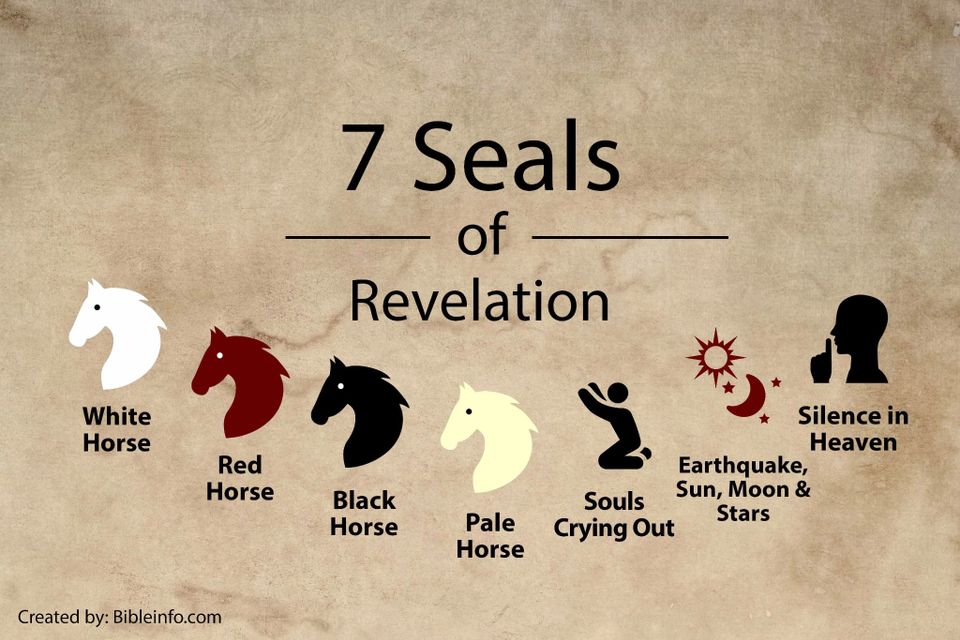
And when he had opened the seventh seal, there was silence in heaven about the space of half an hour.
The Lamb opens the seventh seal: heaven falls silent.
But the LORD is in his holy temple: let all the earth keep silence before him.
Connection: The silence of heaven follows the opening of the final seal. Habakkuk supplies a fitting parallel of reverent silence before the Lord, but does not specify the reason for the half hour.
And I saw in the right hand of him that sat on the throne a book written within and on the backside, sealed with seven seals.
Connection: This seventh seal completes the series on the scroll shown in chapter 5. In our pre-tribulation reading, these are judgments unfolding after the Church has been caught away.
And I saw the seven angels which stood before God; and to them were given seven trumpets.
Seven angels receive seven trumpets.
And the angel answering said unto him, I am Gabriel, that stand in the presence of God; and am sent to speak unto thee, and to shew thee these glad tidings.
Connection: Gabriel describes standing before God. This is a useful parallel to the angels standing before God, but Scripture does not name the seven angels here.
And he shall send his angels with a great sound of a trumpet, and they shall gather together his elect from the four winds, from one end of heaven to the other.
Connection: Trumpets often signal decisive divine action. Matthew 24 describes a gathering, not necessarily the same trumpet event as these judgments.
And another angel came and stood at the altar, having a golden censer; and there was given unto him much incense, that he should offer it with the prayers of all saints upon the golden altar which was before the throne.
The prayers of the saints are presented at the golden altar.
Let my prayer be set forth before thee as incense; and the lifting up of my hands as the evening sacrifice.
Connection: David compares prayer to incense. Here the saints’ prayers are offered with incense before the heavenly throne. The angel is not explicitly identified as Christ.
And the smoke of the incense, which came with the prayers of the saints, ascended up before God out of the angel's hand.
The saints’ prayers rise before God.
And when he had taken the book, the four beasts and four and twenty elders fell down before the Lamb, having every one of them harps, and golden vials full of odours, which are the prayers of saints.
Connection: This earlier heavenly scene explicitly connects odours with the prayers of saints. The prayers remain before God amid the judgments.
And the angel took the censer, and filled it with fire of the altar, and cast it into the earth: and there were voices, and thunderings, and lightnings, and an earthquake.
Fire from the altar is cast to earth.
And it came to pass on the third day in the morning, that there were thunders and lightnings, and a thick cloud upon the mount, and the voice of the trumpet exceeding loud; so that all the people that was in the camp trembled.
Connection: Sinai also displayed thunder and lightning in connection with God’s majesty. In Revelation, fire is cast to earth, marking a solemn transition into the trumpet judgments.
And the seven angels which had the seven trumpets prepared themselves to sound.
The seven trumpet judgments are about to begin.
Blow ye the trumpet in Zion, and sound an alarm in my holy mountain: let all the inhabitants of the land tremble: for the day of the LORD cometh, for it is nigh at hand;
Connection: Joel uses the trumpet as a warning concerning the day of the LORD. The Revelation trumpets announce judgments, not musical celebration.
The first angel sounded, and there followed hail and fire mingled with blood, and they were cast upon the earth: and the third part of trees was burnt up, and all green grass was burnt up.
First trumpet: trees and grass are burned.
And Moses stretched forth his rod toward heaven: and the LORD sent thunder and hail, and the fire ran along upon the ground; and the LORD rained hail upon the land of Egypt.
Connection: The first trumpet recalls the plague on Egypt, but the scale and details differ. The one-third destruction belongs specifically to the first trumpet.
And the second angel sounded, and as it were a great mountain burning with fire was cast into the sea: and the third part of the sea became blood;
Second trumpet: judgment strikes the sea.
And Moses and Aaron did so, as the LORD commanded; and he lifted up the rod, and smote the waters that were in the river, in the sight of Pharaoh, and in the sight of his servants; and all the waters that were in the river were turned to blood.
Connection: Like the Nile plague, this judgment turns water to blood. The text says “as it were a great mountain,” so it describes its appearance without identifying its physical substance.
And the third part of the creatures which were in the sea, and had life, died; and the third part of the ships were destroyed.
Sea life and ships suffer one-third losses.
And the fish that was in the river died; and the river stank, and the Egyptians could not drink of the water of the river; and there was blood throughout all the land of Egypt.
Connection: The death of aquatic life also occurred in the first Egyptian plague. Here the losses extend into the sea and shipping, and Revelation specifies a third part.
And the third angel sounded, and there fell a great star from heaven, burning as it were a lamp, and it fell upon the third part of the rivers, and upon the fountains of waters;
Third trumpet: a burning star strikes fresh waters.
And the fifth angel sounded, and I saw a star fall from heaven unto the earth: and to him was given the key of the bottomless pit.
Connection: John uses falling-star imagery in both passages. In chapter 9 the star is addressed as “him”; chapter 8 does not identify Wormwood as an angel or person. Do not force the two stars to be the same.
And the name of the star is called Wormwood: and the third part of the waters became wormwood; and many men died of the waters, because they were made bitter.
Wormwood makes waters bitter and deadly.
Therefore thus saith the LORD of hosts, the God of Israel; Behold, I will feed them, even this people, with wormwood, and give them water of gall to drink.
Connection: Jeremiah uses wormwood in the context of bitter judgment. Revelation names the falling star Wormwood and reports deadly bitterness in drinking water. The precise nature of the star is not explained.
And the fourth angel sounded, and the third part of the sun was smitten, and the third part of the moon, and the third part of the stars; so as the third part of them was darkened, and the day shone not for a third part of it, and the night likewise.
Fourth trumpet: one third of heavenly lights are darkened.
And Moses stretched forth his hand toward heaven; and there was a thick darkness in all the land of Egypt three days:
Connection: Darkness was also a plague on Egypt. The fourth trumpet differs by affecting one third of the sun, moon, stars, day and night; the fraction is worth noting.
The earth shall quake before them; the heavens shall tremble: the sun and the moon shall be dark, and the stars shall withdraw their shining:
Connection: Joel likewise describes celestial darkness associated with the day of the LORD. This thematic parallel does not require the two texts to describe an identical moment.
And I beheld, and heard an angel flying through the midst of heaven, saying with a loud voice, Woe, woe, woe, to the inhabiters of the earth by reason of the other voices of the trumpet of the three angels, which are yet to sound!
Three solemn woes remain in the last three trumpets.
One woe is past; and, behold, there come two woes more hereafter.
Connection: The remaining three trumpets are the three announced woes. Revelation 9:12 explicitly marks the first as completed.
The second woe is past; and, behold, the third woe cometh quickly.
Connection: The second woe is later declared complete, leaving the third. The book’s own progression explains the warning in verse 13.